
To Please an Emperor: A History of Cristal

An Icon of Elegance and Indulgence
Of all the Champagnes to come out of France’s Grand Cru estates, Cristal is undeniably one of the most famed and certainly the best loved, favored by royalty, actors, celebrities, and the generally well-heeled for well over a century. Produced by the House of Louis Roederer, Cristal is their signature prestige cuvée and is perhaps the most referenced Champagne in pop culture.
Cristal has been praised not just for its exclusivity, but for its precision winemaking. It is typically composed of about 60% Pinot Noir and 40% Chardonnay, drawn from Roederer’s own estate vineyards, which cover 250 hectares in Champagne. Importantly, the grapes used for Cristal come only from the region’s most prized Grand Cru vineyards, underscoring its status as a true luxury cuvée.
Imperial Origins
The oldest prestige cuvée in the world, Cristal still retains the same sparkling charm it had when it was first crafted in 1876 to meet the exacting demands of a discerning, yet autocratic Emperor. In great part, the enduring appeal of Cristal lies in its fascinating history, a history that is intricately linked to the Russian royal family, in particular Tsar Alexander II of Russia. A dedicated ruler and an enlightened reformer, he was a man of exquisite tastes who could be as benevolent as he was brutal.

In the mid-1800s, Louis Roederer was focused on building up the company his uncle had left him in 1833, which he renamed after himself. He found new markets across the continent, as well as in Russia, where he was soon appointed the official vintner to the Imperial Court by Tsar Alexander II. The Tsar was very fond of Roederer’s wines, and in 1876, he asked the French vintner to reserve the best of his house’s wine each year for the Imperial Court. In response, Roederer created an exquisite sparkling wine, Cristal, and along with it, the new and exclusive world of prestige cuvées. This innovation set the template for other producers, including Moët & Chandon’s Dom Pérignon (introduced in 1921), and cemented Roederer’s place in Champagne history.
Security and Symbolism
But there was more to the Tsar’s request than an appreciation for fine wines. By 1876, the beleaguered Tsar had already survived two brazen assassination attempts, the second of which put his sons in danger as well. He was understandably wary at this point of the many threats to his life, and in order to protect himself, he made certain additional stipulations about the bottling of the wine.
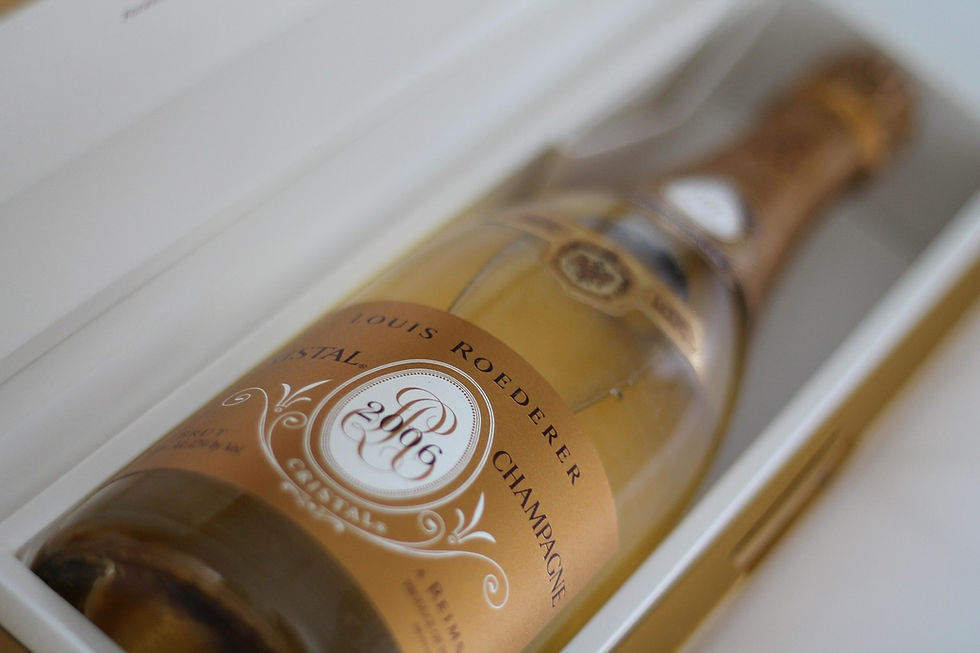
Traditionally, wine came in dark green bottles with an indented base. For the new wine, the Tsar wanted a clear bottle with a flat bottom that would obviate the possibility of poison or any hidden bombs lurking in the base of the bottle. Roederer complied and designed the famed lead crystal flat-bottomed bottle that gave the wine its name and is still used today to bottle the world’s oldest prestige cuvée Champagne.
That distinctive flat-bottom design, coupled with the clear glass, became a visual hallmark of Cristal. Even today, while modern bottles are no longer made of lead crystal for safety reasons, they retain the iconic transparent appearance. To protect the wine from light damage, each bottle is wrapped in an orange cellophane film before release—a tradition that has become instantly recognizable in wine cellars and at exclusive events.
Cristal in the Modern Era

Today, Cristal is produced only in the very best vintages—on average, about 7 to 8 times per decade. Annual production was historically limited to around 300,000 to 400,000 bottles, a fraction of mainstream Champagnes, which adds to its scarcity and prestige, although demand has pushed that figure higher in recent decades.
Its cultural influence has also extended far beyond the wine world. Cristal has been name-checked in songs by artists like Jay-Z and the Notorious B.I.G., featured in films, and served at red-carpet events, making it one of the most recognizable luxury Champagnes in popular culture. Exquisitely crafted, with an intriguing history and royal connections, it is little wonder that Cristal continues to capture the hearts and imaginations of Champagne lovers around the globe.

Comments